Momotarō, the Peach Boy
A Japanese folktale
About 8 min to readTonight’s story comes from Japan. In early summer the rice fields there are bright green, and the rivers are so clear you can see the pebbles on the bottom.
Long ago, an old man and an old woman lived by working for other people. Every day he went up the hills to cut grass for the farmers, while she looked after the house and their little rice field. They were kind and hard-working, and they had one sorrow: they were old now, and they had never had a child.
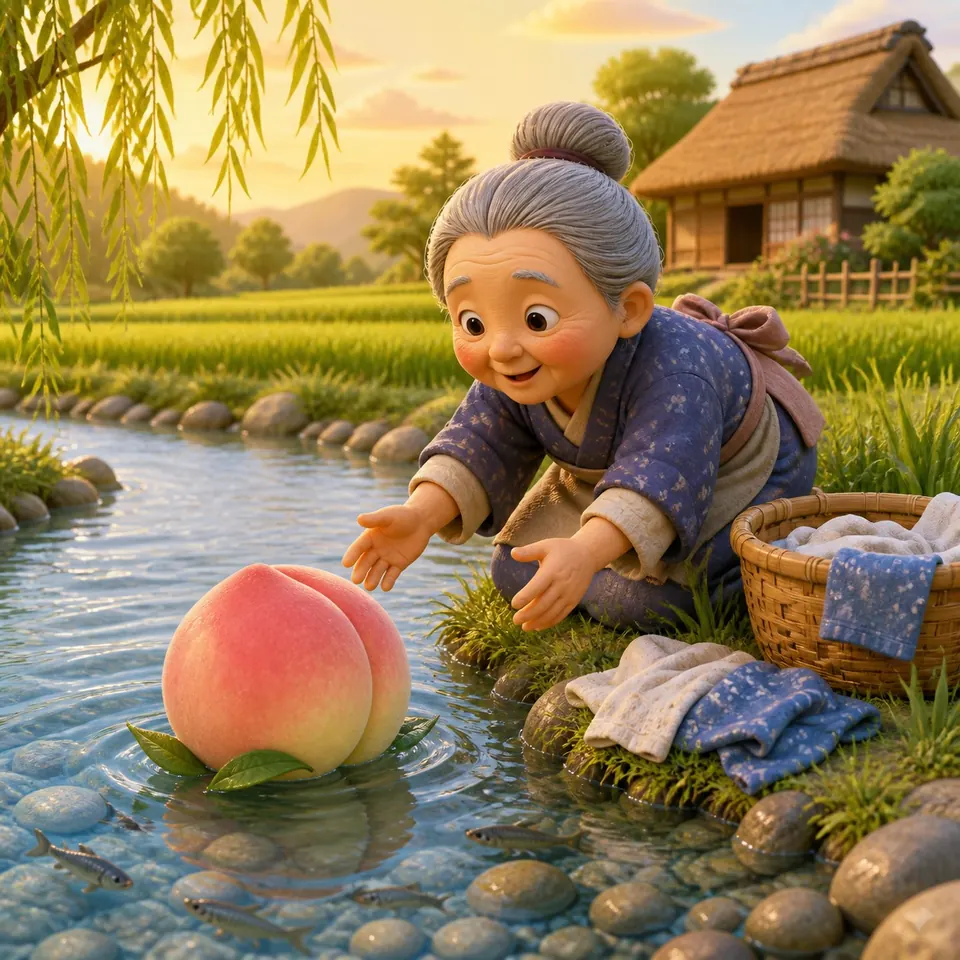
One morning the old man went off to cut grass, and the old woman carried a basket of clothes down to the river. She sat on the bank, washing each piece and rubbing it on the stones. The water was cool and little fish darted back and forth.
While she was washing, she saw a peach come bobbing down the stream. A huge peach. She was sixty years old and had never in her life seen one so big.
“That must be delicious,” she thought. “I have to take it home to my husband.”
She reached out, but it was too far. She looked for a stick, and there wasn’t one. Then she remembered an old rhyme. She clapped in time with the bobbing peach and sang: “Far water is bitter, near water is sweet. Leave the far water and come to the sweet.”
And the peach drifted closer, and closer, until it stopped right in front of her. She was so happy she couldn’t finish her washing. She packed the clothes into her basket, put the basket on her back, and hurried home with the peach in her arms.
The old man came home at sunset, carrying a bundle of grass so big it almost hid him. She had been waiting for ages and showed him the peach. He was amazed, and said he was hungry, so they should cut it and eat it.
He put the peach on a board and lifted the knife, and the peach split in two all by itself. A clear little voice said, “Wait a moment, old man!” and out stepped a beautiful baby boy.
The old couple sat down hard on the floor. The child said, “Don’t be afraid. Every day you have been sad because you had no child. Heaven heard you, and I have come to be your son.”
They were so happy they didn’t know what to do with themselves. First the old man held him, then the old woman did, and they named him Momotarō, which means Peach Boy.
The years went by, and Momotarō turned fifteen. He was taller and stronger than any boy his age, brave, and wise beyond his years. One day he told his father that far out to sea, to the north-east, there was an island of ogres. They came to the mainland to rob people and carry them away. He wanted to go to the island, defeat the ogres and bring back what they had stolen.
The old man was surprised, but he knew this was no ordinary boy, so he let him go. The old couple pounded rice to make dumplings for the journey. When it was time to say goodbye, their eyes filled with tears. “I’m going now,” said Momotarō. “Take care of yourselves. I’ll come back.”
At midday he sat under a tree to eat. A dog almost as big as a pony burst out of the long grass and bared its teeth, demanding his dumplings. But as soon as it heard the name Momotarō, its tail dropped, and it bowed low and asked to come along. Momotarō gave it half a dumpling.
Over the hills and through the valleys they went, until a monkey climbed down from a tree and asked to join them. The jealous dog snarled at it, and the two began to fight. Momotarō stepped between them and gave the monkey half a dumpling too. After that he sent the dog ahead with a flag, put the monkey behind, and walked in the middle himself to keep them apart.
In a wide field, a pheasant with five colours of feathers and a scarlet crest flew down. The dog went for it, and the pheasant fought right back. Momotarō held the dog back and told the pheasant to stop fighting and join them instead. The pheasant asked to come, and got half a dumpling.
Then Momotarō stood before all three and said, “To beat the ogres, the first thing we need is to get along. From now on you three are friends, all of one mind. Whoever starts a quarrel goes home.” They promised, and from then on they really were friends.
At the shore, the animals saw the sea for the first time and just stared at each other, scared. But they found their courage and climbed into a small boat with Momotarō. The wind was kind and the boat flew like an arrow. On the long days at sea they told each other stories and played games, until one sunny morning they saw the ogres’ island, with a great castle on top of the cliffs.
The pheasant flew ahead, landed on the castle roof and called on the ogres to give up. The ogres, with their horns and red hair and iron clubs, laughed at the bird. The pheasant flew round and round them, beating its wings so fast they couldn’t tell how many birds there were.
Meanwhile Momotarō came ashore with the dog and the monkey. By a stream they met two young women crying as they washed clothes. The ogres had carried them off to be servants. Momotarō promised to rescue them, and they showed him a tiny door at the bottom of the castle wall, so small he had to crawl through.
The four friends charged in, fighting like a hundred, and the ogres could not stand against them. At last the ogre chief knelt, threw down his iron club and broke off his own horns to show he surrendered. Momotarō tied him up and left the monkey to guard him. Then he went through every room in the castle, set all the prisoners free and gathered up the stolen treasure.
The two young women and all the other prisoners were taken safely home to their families. The dog and the pheasant carried the treasure, and the whole countryside came out to welcome Momotarō back.
And at the little house by the river, an old man and an old woman ran to the door and saw their son coming home.