Bunbuku Chagama, the Lucky Tea Kettle
A Japanese folktale linked to Morinji Temple
About 7 min to readTonight’s story comes from Japan, from what is now Gunma Prefecture. There is a temple there called Morinji, and people say it still keeps the tea kettle from this story. The hero is a tanuki, a kind of raccoon dog found in Japan. In old Japanese tales, tanuki are mischievous creatures that can change into all sorts of things.
Long ago, at Morinji Temple, there lived an old priest. More than anything he loved making tea. He also loved a good bargain.
One day, in a little shop in a back street, he spotted an old tea kettle, rusty and dusty, lying forgotten in a corner. “An ugly old thing,” he said to the shopkeeper, “but it’ll do for boiling water in the evening. I’ll give you three coins for it.” He took it home, quietly delighted, because it was made of bronze, beautifully worked, just right for the tea ceremony.
A young monk scrubbed the kettle until it shone. The priest set it on a box covered with a purple cloth and gazed at it, and gazed at it, until his eyes grew heavy and he nodded off to sleep.
And then the strange thing happened. The kettle moved all by itself. Out of the spout came a furry head with two bright eyes. The lid hopped up and down. Out popped four furry brown paws and a big bushy tail. In a moment the kettle had jumped down from the box and was walking round the room, looking at everything.
“What a comfortable room,” said the kettle. Then it began to dance and sing at the top of its voice.
The young monks in the next room heard the racket and peeped through the door. “Help!” cried one. “The master’s kettle has turned into a tanuki!” They all rushed in to catch it. But the kettle jumped, the kettle flew, the kettle somersaulted through the air. The monks slipped and slid on the mats and ran out of breath. The kettle laughed, “Ha ha! Catch me if you can!”
The priest woke up. “What is all this noise?” “Master, your kettle turned into a tanuki and danced all over the room!” The priest looked. The kettle was sitting quietly on its box, hard and cold, without a single hair on it. He told the monks to stop talking nonsense and get back to their books.
That evening the priest filled the kettle with water and put it on the charcoal to boil for his tea. As soon as the water boiled, the kettle cried out, “Ow! Ow! Too hot, too hot!” and leapt off the fire.
The priest got the fright of his life. The very next morning he sold the kettle to a passing tinker who mended pots and pans.
The tinker took it home, turned it this way and that, and was very pleased with it. That night he put it right beside his bed. At midnight he woke and looked at the kettle in the moonlight. It moved. Out came the furry head, the four paws and the tail. It came close and laid a paw on his hand.
“Well?” said the tinker. He was a man who took things as they came. “I’m not wicked,” said the kettle. “I just like to be treated kindly. At the temple they called me names and put me on the fire. I couldn’t bear it.” “I understand,” said the tinker. “I think I’ll stay with you. Don’t shut me away in a box. Keep me by you, and we can chat now and then. I like rice, and beans, and sweet things.” “That suits me,” said the tinker.
So the tinker and the kettle became the best of friends. They ate together and talked together. The kettle knew all sorts of things and was wonderful company.
One day the kettle asked, “Are you poor?” “Fairly poor,” said the tinker. “Then I have an idea. My name is Bunbuku Chagama, the finest tanuki tea kettle in the world. Take me round as a show and you’ll make a fortune.” “That would be hard work for you,” said the tinker. “Not at all. Let’s start right away.”
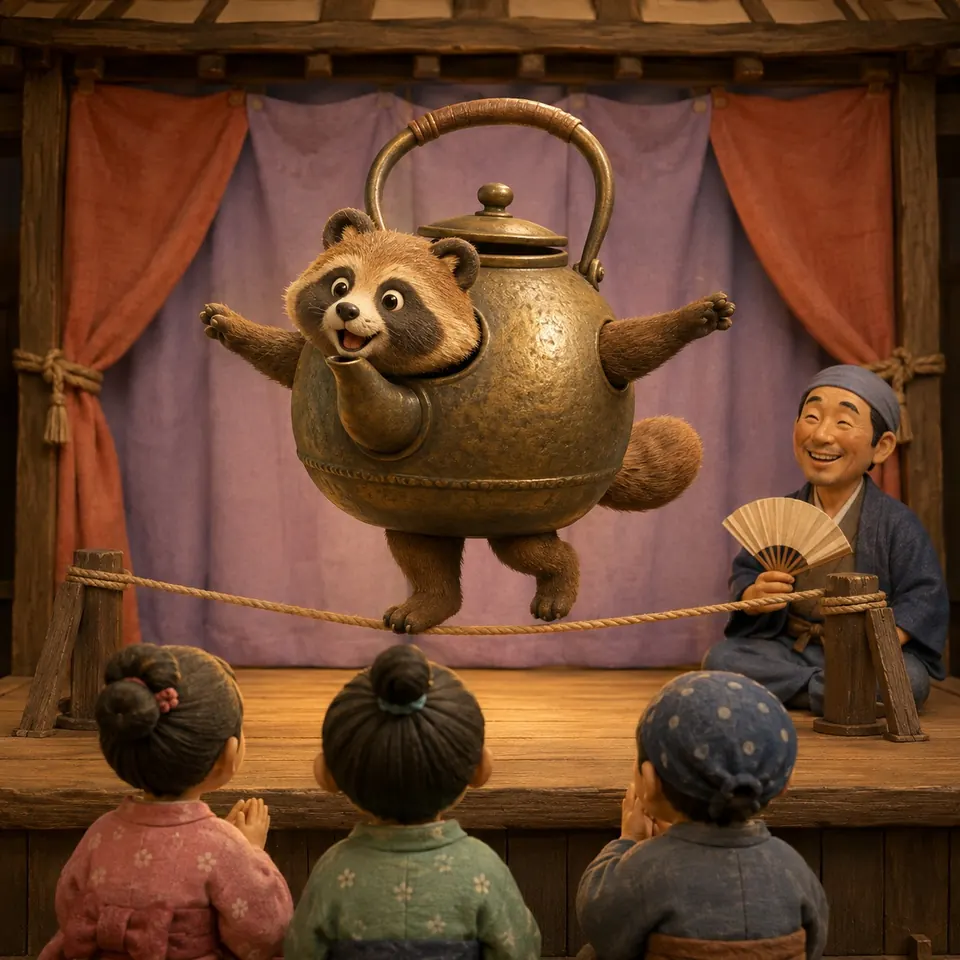
The tinker bought some cloth, set up a little theatre and called it the Bunbuku Chagama Show. People came in crowds. The kettle danced and sang and walked the tightrope as if it had been born to it. It did such funny tricks that everyone laughed till their sides ached. At the end it bowed as gracefully as a lord. And the tinker sat beside the stage, fanning himself and taking the money.
Bunbuku Chagama became famous across the whole countryside. Even the grandest people came to see it. The tinker was invited to the royal court, where all the ladies and princesses adored the kettle.
When the tinker had become rich and stopped giving shows, the kettle came to him with tears in its bright eyes. “I’m afraid it’s time for me to leave you.” “Don’t say that, dear Bunbuku. We’re rich now. Let’s just be happy together.” “My time has come to an end. You won’t see Bunbuku any more. From now on I’ll be an ordinary kettle.” “Oh, Bunbuku,” cried the tinker, “whatever shall I do?” “I would like to be given to Morinji Temple, as a treasure.”
After that, the kettle never spoke or moved again. The tinker took it to Morinji and gave it to the temple as a treasure, together with half of everything he owned.
And at that temple, the bronze kettle was looked after with great care for many, many years.