The Monkey King and the Crocodile
An Indian Jātaka tale (Vānarinda Jātaka)
About 5 min to readTonight’s story comes from India, a country of wide, slow rivers lined with green forest. Monkeys live in the trees along the banks, and crocodiles live in the water.
Long ago, on the bank of a river like that, there lived a monkey all on his own. He was huge, as big as a young horse and as strong as an elephant.
In the middle of the river was a small island, covered in fruit trees: mangoes, jackfruit and all sorts of others. When the fruit was ripe, the breeze carried the smell all the way to the bank.
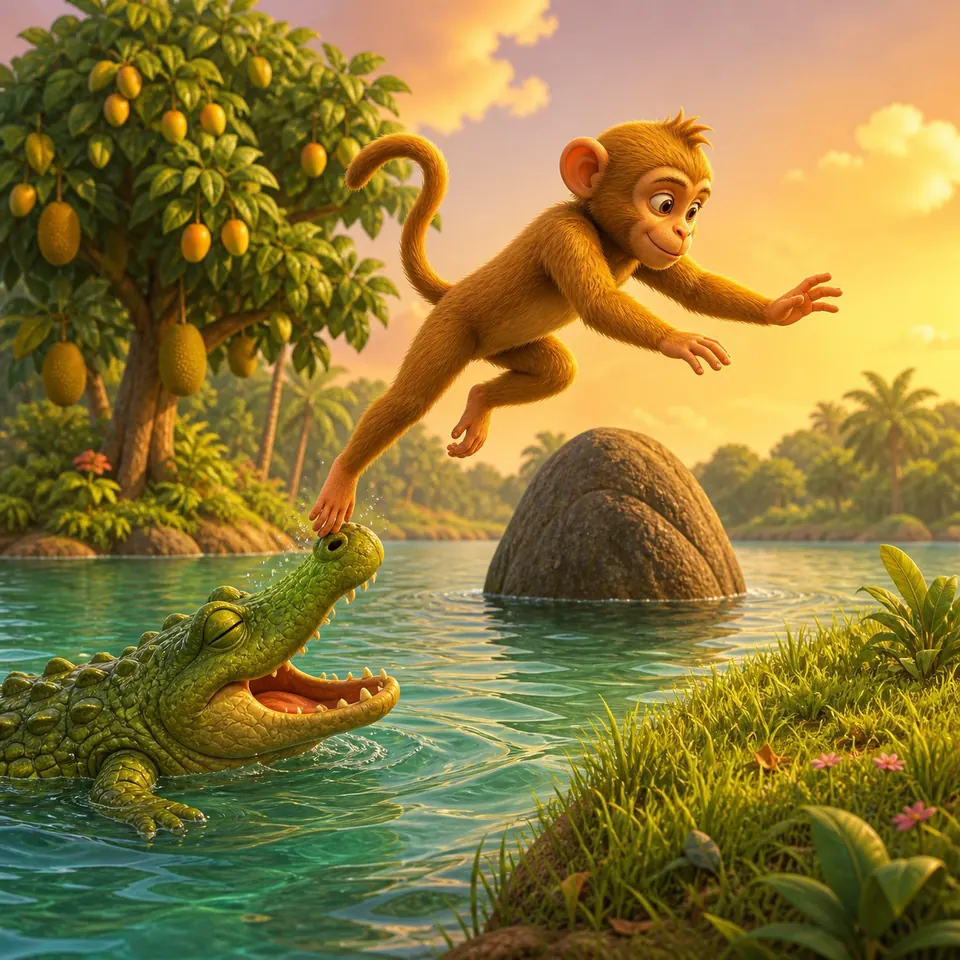
The island was a long way from the bank, but halfway across, a single rock stuck up out of the water. Every morning the monkey took a run-up, jumped from the bank onto the rock, and from the rock onto the island. He spent the day eating his fill of fruit. In the evening he jumped back onto the rock, then onto the bank, and went home to sleep.
In the river lived a crocodile and his wife. The wife was about to lay her eggs. Every day she watched the big monkey leaping back and forth over her head, and she began to crave the monkey’s heart.
“Catch that monkey for me,” she told her husband.
The crocodile promised he would. He thought for a while, then climbed up and lay flat over the top of the rock in the middle of the river. He lay perfectly still and waited for the monkey to come home in the evening.
That evening the monkey, full of fruit, stood at the edge of the island and looked towards the bank. Every day he paid attention to the water and the rock, so he knew exactly how high each of them should be. Today the river was the same as always. But the rock looked taller and bigger.
That’s odd, thought the monkey. The water hasn’t gone down, so why is the rock higher? Could a crocodile be lying there waiting for me?
He didn’t jump. Instead he called out, “Hello, rock!”
No answer.
“Hello, rock! Hello, rock!”
Still nothing. After calling three times, the monkey asked, “Friend rock, why won’t you answer me today?”
The crocodile thought: so the rock talks to this monkey every day. I’d better answer for it, or he’ll get suspicious. So he called back, “Yes, monkey? What is it?”
“Who are you?” asked the monkey.
“I’m a crocodile.”
“What are you doing there?”
“Waiting to catch you and eat your heart.”
The monkey stood still on the island. He knew he couldn’t stay there forever, and there was only one way home, across the rock. He didn’t panic. He thought quickly and said, “Then I have no choice. Open your mouth, and I’ll jump, and you can catch me.”
The crocodile was delighted and opened his mouth as wide as it would go. Now, when a crocodile opens its mouth wide, its eyes close tight.
At that very moment, the monkey took a run-up, leapt, and landed right on top of the crocodile’s head. From there he sprang again, quick as lightning, and landed safely on the bank.
When the crocodile opened his eyes, the monkey was already sitting on the riverbank. He knew he had been tricked. But he wasn’t angry. He looked at the monkey and said, “Monkey King, whoever has four things like you do, keeping their word, seeing ahead, sticking to their decision and having no fear, will see every enemy run away.”
Then the crocodile slid back into the water and went home. And the monkey sat on the bank, watching the rock in the middle of the river fade into the evening shadows.