The Elves and the Shoemaker
A German fairy tale collected by the Brothers Grimm
About 5 min to readTonight’s story comes from Germany, a land of steep-roofed villages and dark pine forests, where snow covers the cobbled streets in winter.
Long ago, in a small town, there lived a shoemaker. He worked hard and sewed beautifully, yet somehow, through no fault of his own, he grew poorer and poorer. At last there was only one piece of leather left in his workshop, just enough for one pair of shoes.
That evening he sat at his bench and carefully cut the leather into pieces, laying them out neatly so he could start sewing in the morning. Then he went to bed. He had done nothing wrong, so poor as he was, he slept peacefully.
The next morning he got up, went to his bench, and stopped dead.
On the table stood a finished pair of shoes. He picked them up and turned them over and over. Every stitch was straight and even, not one out of place. They were so fine they looked like a master’s work, made for show.
Soon a customer came in. He tried the shoes on, loved them, and paid more than the usual price. With that money the shoemaker could buy leather for two pairs.
That night he cut out two pairs, laid them on the bench and went to bed. In the morning, when he sat down to work, two finished pairs were waiting for him. Customers came again, and now he had money for leather for four pairs.
The next morning the four pairs were finished too. And so it went on. However much leather he cut in the evening, that many fine shoes stood ready by morning. Before long he was earning an honest living again, and in time he became well off.
One evening not long before Christmas, after cutting out the leather, he turned to his wife and said, “Why don’t we stay up tonight and see who’s been helping us?”
His wife liked the idea. They lit a candle, hid in a corner of the room behind some clothes hanging on a peg, and waited.
At midnight, two tiny little men appeared. They sat down at the shoemaker’s bench, took the cut-out leather, and began to stitch and sew and hammer. Their little fingers moved so quickly that the shoemaker couldn’t take his eyes off them. They kept going until every pair was done and standing on the table, and then they ran off.
The next morning his wife said, “Those little men have helped us so much, and we must thank them. They run about with no clothes on at all, they must be freezing. I’ll make them each a shirt, a coat, a waistcoat and trousers, and knit them some stockings. You make them each a pair of shoes.”
The shoemaker smiled. “I’ll start right away.”
They worked on it for days. When everything was ready, they laid the presents on the bench instead of the leather, and hid again to watch.
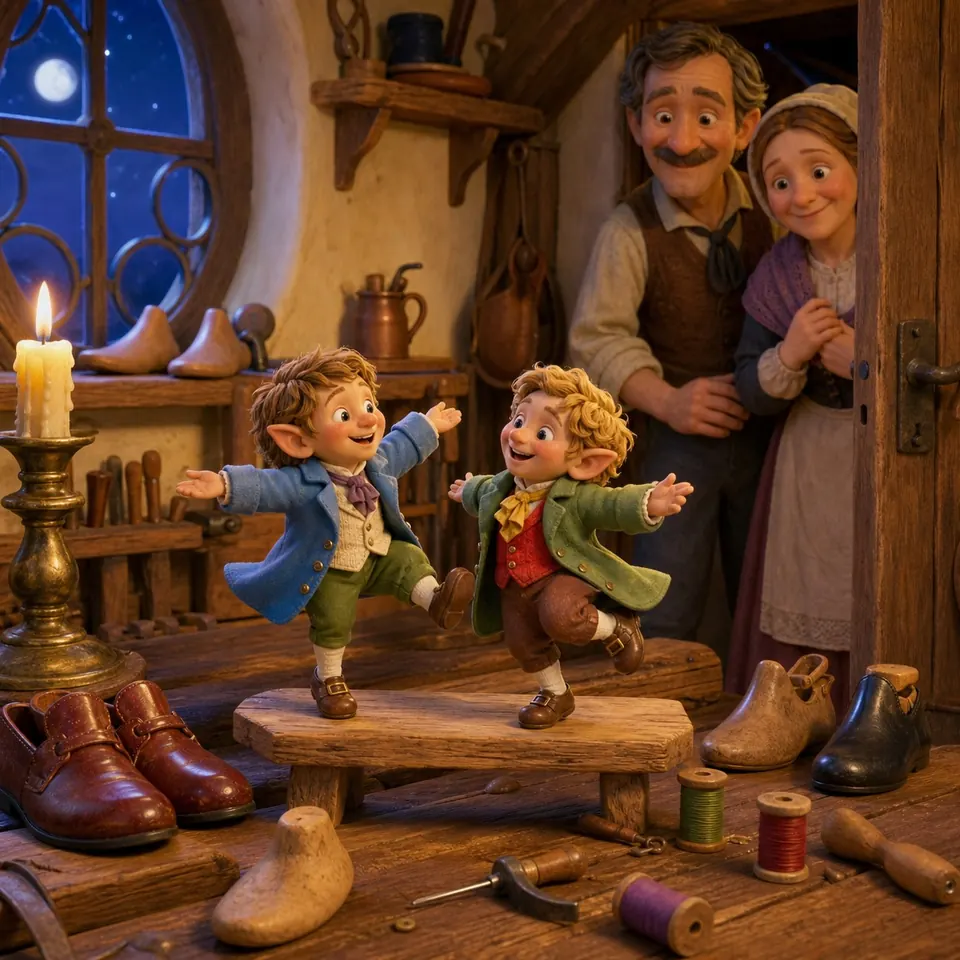
At midnight the little men came skipping in, ready to start work. But there was no leather on the table, only the clothes. At first they were astonished. Then they were overjoyed. They pulled on their new clothes as fast as they could, singing: “Look how fine we are today! No more shoes, we’re off to play!”
Then they danced and skipped and jumped over the chairs and the benches, round and round the room, and right out of the door.
They never came back after that. But for the rest of his life, everything the shoemaker turned his hand to went well, and the candle in his little workshop still glowed every evening.