The Little Red Hen
An old English folk tale
About 5 min to readTonight’s story comes from England, a land of small farms with low stone walls, green fields, and wheat that turns golden at the end of summer.
Long ago, in a farmyard, there lived a little red hen. She was always busy. She went pecking and scratching all over the yard, looking for worms for her chicks. Every time she found a fat one she called, “Cluck, cluck, cluck!” and her fluffy yellow chicks came running.
Three other animals lived in the yard. A cat who spent all day napping in the barn doorway. A big fat rat who ran about wherever he pleased. And a pig in his sty, who didn’t care about anything as long as he could eat and get fat.
One day the little red hen scratched up a seed. At first she thought it was a worm, because it was long and thin. But when she pecked it, it tasted nothing like a worm. She asked around and found out it was a grain of wheat. If you planted it, it would grow and ripen, and then it could be ground into flour and made into bread.
The hen knew it ought to be planted. But she was so busy finding food for her family. She thought of the pig, who surely had time to spare, the cat, who had nothing to do, and the rat, who idled away his days. So she called out loudly, “Who will plant the wheat?”
“Not I,” said the pig. “Not I,” said the cat. “Not I,” said the rat.
“Then I will,” said the little red hen. And she did.
All through the long summer days, the hen kept scratching for worms and feeding her chicks. The pig grew fat, the cat grew fat and the rat grew fat. And the wheat grew tall and turned golden.
One day the hen noticed the wheat was ripe. She ran about calling, “Who will cut the wheat?”
“Not I,” said the pig. “Not I,” said the cat. “Not I,” said the rat.
“Then I will.” And she fetched the sickle from the barn and cut it all down.
The wheat lay on the ground, ready to be threshed. But just then her smallest chicks started peeping loudly for their mother. The hen hardly knew which way to turn. Still hopeful, she called, “Who will thresh the wheat?”
“Not I,” grunted the pig. “Not I,” mewed the cat. “Not I,” squeaked the rat.
The hen sighed. “Then I will.” She fed her chicks first, waited until they were down for their afternoon nap, and then threshed the wheat.
“Who will carry the wheat to the mill?”
The three animals turned their backs. “Not I.” “Not I.” “Not I.”
“Then I will.” The hen picked up the sack of wheat and trudged all the way to the faraway mill. The miller ground it into fine white flour, and she trudged all the way home again with the flour. When she got back, her chicks were so happy to see her.
The next morning the hen woke up thinking: today that flour must become bread. After feeding her chicks, she went to find the pig, the cat and the rat. “Who will make the bread?”
“Not I.” “Not I.” “Not I.”
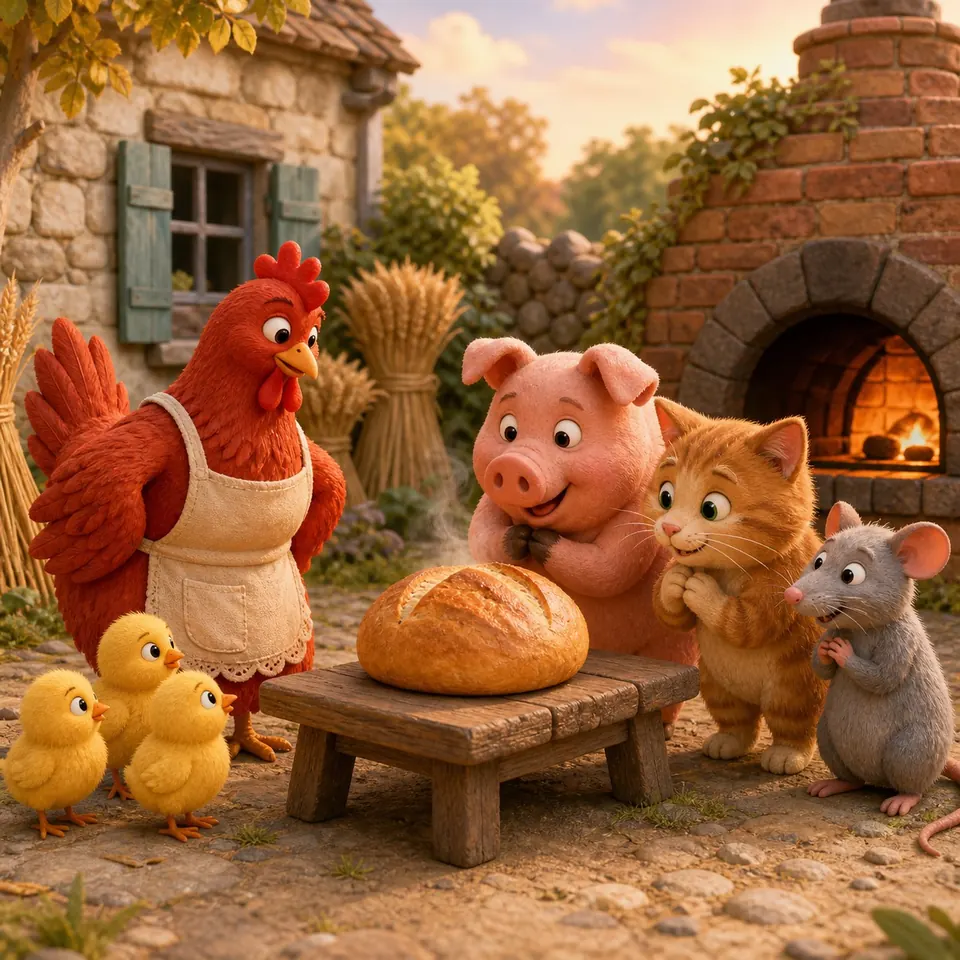
“Then I will.” She put on a clean apron and a cook’s cap. She mixed the dough, let it rise, shaped it into loaves and put them in the oven. All the while the cat sat nearby giggling, the rat admired himself in a mirror, and the pig snored away.
Then a wonderful smell drifted across the yard, and every animal sniffed the air. When the loaves came out of the oven, golden brown and perfectly baked, the hen was so happy she wanted to dance and sing.
Out of habit, she called, “Who will eat the bread?”
“I will!” said the pig. “I will!” said the cat. “I will!” said the rat.
But the little red hen said, “No, you won’t. I will.”
And she did.